We have been working through a series on the book of Revelation. This book of the Bible can be difficult to understand for a variety of reasons, so we are taking it slow and studying it bit by bit together. We continue our study of Chapter 4 as John is invited to enter God’s throne room.
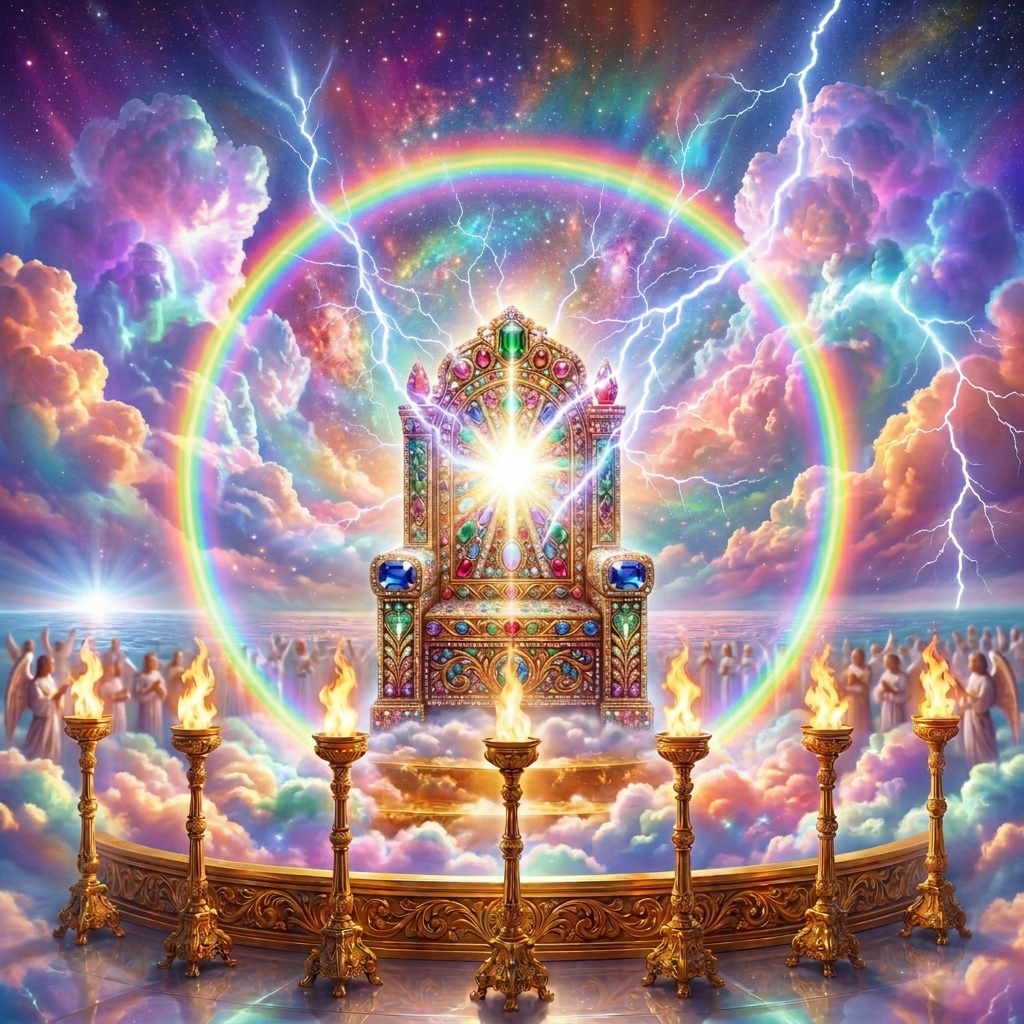
In verse 5, John describes what he saw. “From the throne came flashes of lightning and the rumble of thunder. And in front of the throne were seven torches with burning flames. This is the sevenfold Spirit of God.”
John continues to describe the power and majesty of God, painting a vivid picture of divine splendor. From His throne comes lightning and thunder, signaling His authority and wondrous might over the universe. God is the Creator of all things; everything flows from Him, including the very forces of nature.
In front of God’s throne are seven torches with burning flames. These seven torches are the sevenfold Spirit of God, the Holy Spirit. It is essential to note that these torches are not to be confused with the seven lampstands that we read about in Chapter 1 of Revelation, which represent the seven churches. We studied the seven lampstands that Jesus walks among in a prior post. Instead, the seven torches signify the fullness of the Holy Spirit, emphasizing the divine presence that guides, inspires, and empowers believers.
May we picture the vibrant colors of heavenly glory around us as we approach the throne in prayer (Hebrews 4:16), inviting us into a deeper communion with Him. Each time we pray, we enter a sacred space. In the throne room are the Father, the Son and the Holy Spirit surrounded by a multitude of angels, heavenly creatures, and 24 elders, whose voices rise in worship. When we pray and praise, we join those in the throne room and declare the majesty of the Creator, celebrating His sovereignty and grace. May we sing praises to our God, reminding us of the unfathomable love and mercy that flows from Him, nourishing our spirits and renewing our hearts.
Let’s pray. Father in heaven, thank You for Jesus, our light and hope. Thank You for Your love that surrounds us daily. Thank You for the Bible, which guides and inspires us through life’s challenges. Help us to apply Your Word in our lives, reflecting Your love and grace in our relationships. Guide us as we study Revelation, giving us understanding of its mysteries. May Your Holy Spirit enlighten us and help us live according to Your will. In Jesus’ name we pray, amen.
We have been working through a series on the book of Revelation. This book of the Bible can be difficult to understand for a variety of reasons, so we are taking it slow and studying it bit by bit together. As we begin our study of Chapter 4, John is invited to enter God’s throne room.
In verse 1 of Chapter 4, John writes, “Then as I looked, I saw a door standing open in heaven, and the same voice I had heard before spoke to me like a trumpet blast. The voice said, ‘Come up here, and I will show you what must happen after this.’ ”
Up to this point in Revelation, Jesus was telling John what to write. In Chapter 4, John begins to describe in his own words what he sees. Jesus literally opens the door to heaven’s throne room and tells John to come up. Heaven is not accessible to humans except through Jesus. John 14:6 says, “Jesus told him, ‘I am the way, the truth, and the life. No one can come to the Father except through me.’ “
God the Father is in the throne room of heaven and the only way to Him is through Jesus opening the door. If someone who does not believe in Jesus as the Son of God tries to open the door, they are forbidden entrance (see Matthew 25 where Jesus uses several parables to explain this).
When Jesus says He is going to show John what must happen after “this”, He is referring to after the Church age. “This” is the present time we are living in, which we studied in a prior post. Jesus is revealing to us what the future holds, He does not want us to be unaware.
As we enter the throne room of heaven, there is constant activity and songs of praise to God. It is a room filled with God’s glory, grace, and joy. God’s beauty and magnificence create a radiant light, and there is an atmosphere of worship, reverence, and adoration.
Beginning in verse 2, John describes what he saw. “And instantly I was in the Spirit, and I saw a throne in heaven and someone sitting on it. 3 The one sitting on the throne was as brilliant as gemstones—like jasper and carnelian. And the glow of an emerald circled his throne like a rainbow.”
John is led by the Holy Spirit through an open door into heaven’s throne room, guiding him into the very presence of God. Every believer has this gift, the Holy Spirit can take us to the throne room right now. Through our belief in Jesus as the Son of God, we are invited to the throne of grace (Hebrews 4:16). John sees God on His throne and attempts to describe the incredible glory surrounding Him. Scriptures tell us that God is light, so there is no need for the sun or moon in heaven since God’s glory provides the light (1 John 1:5, Revelation 21:23). John uses jewels and colors to depict the breathtaking beauty that surrounds God.
In verse 4, John continues to describe what he sees. “Twenty-four thrones surrounded him, and twenty-four elders sat on them. They were all clothed in white and had gold crowns on their heads.”
The 24 elders sitting on thrones are the 12 patriarchs from the Old Testament and the 12 apostles from the New Testament, illustrating the unity of God’s people across both covenants. These elders have several roles that emphasize their importance in the heavenly realm. They sing praises to God and fill His throne room with songs of worship. Another significant role of the elders is to interpret the visions that John will see in Chapters 5 and 7, guiding him through the complexities of divine revelation. The elders are wearing white, the same as the other believers described throughout the book of Revelation, symbolizing purity and holiness. Jesus is also described as wearing white; we studied this topic in a prior post.
God’s throne room is the center of the rest of the book of Revelation. As we study the throne room and the wrath that will occur on earth, we must remember these are not fairy tales. The throne room exists today, Jesus is seated at the right hand of God the Father today (Matthew 26:64, Mark 14:62 and Hebrews 12:2).
Let’s pray. Father in heaven, thank You for Jesus, who is our guiding light and hope. Thank You for Your immense love for us, which surrounds us in every moment of our lives. Thank You for the wisdom that we have in the Bible, a treasure trove of guidance and inspiration that helps us navigate the challenges of this world. Lord, help us to apply Your Word in our everyday lives, that we may reflect Your love and grace in our actions and relationships with others. Lord, help us to study Revelation with open hearts and minds, and give us understanding as we seek to grasp the mysteries within it. May Your Holy Spirit illuminate our souls and grant us the discernment to live according to Your will. In Jesus’ precious name we pray, amen.
We have been working through a series on the book of Revelation. This book of the Bible can be difficult to understand for a variety of reasons, so we are taking it slow and studying it bit by bit together. As we begin our study of Chapter 4, John is invited to enter God’s throne room.
Chapter 4 is focused on John describing what the throne room looks like and it is an amazing sight! While Chapter 5 is still in the throne room, the revelation of Jesus changes from one of beauty and joy to one of warning.
In the throne room are the Father and the Son, who are sovereign and hold all power in their hands. They are surrounded by a multitude of angels, whose voices rise in worship, creating a scene of reverence and awe. As the book of Revelation continues to unfold, the worship in the throne room transitions dramatically to stark scenes of the unleashing of God’s wrath upon the earth. Those who do not believe in Jesus as the Son of God are exposed to the profound depths of God’s judgment. The purpose of this judgment is not merely punitive but serves as a crucial opportunity for those who do not believe to repent, turning their hearts towards the grace and mercy that is extended through faith in Christ. It is a solemn reminder of the duality of God—love and judgment coexist, urging humanity towards Jesus.
As we proceed to study the throne room and the awful wrath on earth, we must remember these are not fairy tales. The throne room exists today, Jesus is seated at the right hand of God the Father – today (Matthew 26:64, Mark 14:62 and Hebrews 12:2). The wrath that is to be poured out on the earth will indeed happen, and it serves as a reminder of God’s justice and the consequences of sin. If you have accepted Jesus as the Son of God, then you will be saved and protected from this impending judgment. However, if you have refused the gift of salvation that Jesus offers, then you will endure the wrath of God; whether at the moment of your death or when Jesus returns and if you are alive on earth during that time. This urgent message carries the importance of the need for each individual to reflect upon their spiritual state. If you are saved, who do you need to tell about Jesus so they can also avoid the wrath of God and experience the hope and joy that comes from eternal life? Who needs your words to open the door for them to also embrace the truth and grace found in accepting Christ as their Savior?
Let’s pray. Father in heaven, thank You for Jesus. Thank you for our churches. Thank You for the wisdom that we have in the Bible. Lord, help us to apply Your Word in our everyday lives. Lord, help us to study Revelation and give us understanding. In Jesus’ precious name we pray, amen.
We have been working through a series on the book of Revelation. This book of the Bible can be difficult to understand for a variety of reasons, so we are taking it slow and studying it bit by bit together.
As we finish our study of the seven letters to the churches in Chapters 2 and 3, it’s important to remember that the seven churches represent all churches; every church fits into one of the seven types described by Jesus. Also in each letter, Jesus made a promise to believers who stay strong in their faith; these promises apply to all believers throughout time.
The last promise Jesus made in the letters to the churches is in Chapter 3, verse 21. “Those who are victorious will sit with me on my throne, just as I was victorious and sat with my Father on his throne.”
Next week, we will begin to study Chapter 4 of Revelation, a pivotal part of the text that draws us deeper into the divine revelation. John will be told to “come up” to heaven. During the initial chapters of Revelation, Jesus guides John through a series of revelations that are meant to encourage and instruct the various churches. In Chapter 4, Jesus tells John to come to the throne room in heaven, a magnificent and awe-inspiring experience where God’s glory is fully manifested. This is the same throne that Jesus talked about in His promise to all believers when He stated, “Those who are victorious will sit with me on my throne, just as I was victorious and sat with my Father on his throne.” This promise to be in the presence of Jesus’ divine authority serves as a powerful reminder of the hope that awaits believers. Just as John was invited into this heavenly reality, we have an invitation of our own; beckoning us to deeper communion with the divine and a fuller understanding of the heavenly promises that lie ahead.
Let’s pray. Father in heaven, thank You for Jesus. Thank you for our churches. Thank You for the wisdom that we have in the Bible. Lord, help us to apply Your Word in our everyday lives. Lord, help us to study Revelation and give us understanding. In Jesus’ precious name we pray, amen.
We have been working through a series on the book of Revelation. This book of the Bible can be difficult to understand for a variety of reasons, so we are taking it slow and studying it bit by bit together.
In Chapter 3, we find the final letter to the seven churches. The city of Laodicea was situated 45 miles southeast of Philadelphia. Many of the churches—including Pergamum, Thyatira, Sardis, Philadelphia, and Laodicea—were located along the same main road. Laodicea itself was 100 miles east of Ephesus and was particularly known for its luxurious black wool, a desirable commodity, making the city prosperous. The city also had a school of medicine, attracting scholars and practitioners, as well as a temple dedicated to Men Karou, the god of healing. In addition, the Laodiceans also honored the Roman god Zeus and the city was home to a significant Jewish community.
Laodicea, similar to Philadelphia, was located in an earthquake-prone region. As a result, earthquakes frequently caused substantial damage, but the wealthy citizens of Laodicea had the resources to rebuild their city. Despite their affluence, the city faced a significant challenge: it lacked its own water supply. To address this need, water was transported through a system of aqueducts that spanned six miles, bringing in fresh water from surrounding areas. On either side of Laodicea, there were two neighboring cities, each offering a natural water source; one hot springs, while the other provided cold water.
In Chapter 3 of Revelation, starting in verse 14, Jesus says to John, “To the angel of the church in Laodicea write: These are the words of the Amen, the faithful and true witness, the ruler of God’s creation.”
As with the other letters to the churches, Jesus begins by describing Himself. He is the Amen, which means certain or ‘so be it’, His words are true. Jesus also calls Himself the true witness and ruler of God’s creation. Colossians 1:15 says, “Christ is the visible image of the invisible God. He existed before anything was created and is supreme over all creation,16 for through him God created everything in the heavenly realms and on earth. He made the things we can see and the things we can’t see—such as thrones, kingdoms, rulers, and authorities in the unseen world. Everything was created through him and for him.17 He existed before anything else, and he holds all creation together.”
In verse 15 Jesus continues, “I know your deeds, that you are neither cold nor hot. I wish you were either one or the other! 16 So, because you are lukewarm—neither hot nor cold—I am about to spit you out of my mouth.”
As with the other letters, Jesus makes it clear that He is not a far-off or removed God but is actively involved in the lives of His followers. He walks among His people and is intimately aware of the condition of every church: their deeds, struggles, triumphs, and how deeply they love Him. To the believers in Laodicea, He delivers a hard message that challenges them to reflect on their spiritual condition. Jesus expresses that the church’s deeds and their tepid love for Him make Him feel sick. Their lukewarm faith is unsatisfactory.
Whether the water was coming from the cold springs or the hot springs, by the time it reached Laodicea, it had become lukewarm after a six-mile journey through the aqueducts. The water immediately surrounding Laodicea was undrinkable with heavy mineral deposits, resulting in vomiting when consumed. This is why the inhabitants had to pipe in water from nearby sources. Jesus’ warning serves as a wake-up call for the believers to ignite their passion and recommit themselves wholeheartedly to Him.
Jesus continues in verse 17, “You say, ‘I am rich; I have acquired wealth and do not need a thing.’ But you do not realize that you are wretched, pitiful, poor, blind and naked. 18 I counsel you to buy from me gold refined in the fire, so you can become rich; and white clothes to wear, so you can cover your shameful nakedness; and salve to put on your eyes, so you can see.”
The immense wealth in Laodicea created a dangerous complacency that dulled their spiritual awareness and blinded them to their true condition. Jesus rebukes them by telling them that they may have money and material possessions, but they are in a very poor state, spiritually impoverished. Their emphasis on earthly wealth has caused them to overlook the rich treasures found in a relationship with God. Their lives are consumed by the pursuit of material things versus the kingdom of God. This misplaced focus results in their blindness and shame leading them away from the joy and fulfillment that come from living in alignment with God.
Jesus then gives the church advice, “buy from me gold refined in the fire, so you can become rich; and white clothes to wear, so you can cover your shameful nakedness; and salve to put on your eyes, so you can see.” Jesus is not selling clothes or gold, instead He is warning the church to invest in the Kingdom of God versus worldly goods. If the church continues to be focused on their wealth versus their faith, they will undergo trials.
Jesus uses trials to discipline and strengthen His followers. Although these challenges can be painful, it’s crucial for our faith to be purified like gold in a fire. 1 Peter 1:17 says. “These trials will show that your faith is genuine. It is being tested as fire tests and purifies gold—though your faith is far more precious than mere gold. So when your faith remains strong through many trials, it will bring you much praise and glory and honor on the day when Jesus Christ is revealed to the whole world.”
The white clothes that Jesus refers to symbolize the righteousness from His blood. No matter how fancy or beautiful their clothes may have been, none matter except those that have been washed with the precious blood of Jesus. Salve for their eyes would have been familiar to the Laodiceans as one of the medical advancements from the local medical school was a salve for the eyes. The salve that Jesus refers to is for removing the spiritual blindness of the believers.
In verse 19, Jesus explains why He will send trials. “Those whom I love I rebuke and discipline. So be earnest and repent. 20 Here I am! I stand at the door and knock. If anyone hears my voice and opens the door, I will come in and eat with that person, and they with me.”
Jesus loves all of His children and will use discipline to refine and grow faith and trust in Him. He stands at the door to every person’s heart and He knocks gently, patiently waiting for our response. Jesus will not enter your life against your will; instead, He offers an invitation that still stands today and every day. This call to open our hearts to Him is one filled with love and grace. He is knocking, and all you have to do is take that step to open the door to your heart. Jesus will come in, no matter who you are or what you have done; it does not matter the weight of your past or the struggles you have. He will come into your heart and fellowship with you, bringing healing, joy, and a profound sense of belonging that fills you with peace. The moment you invite Him in, you begin a transformative journey where His presence changes your life from within, nourishing your soul in ways you never thought possible.
Jesus concludes His letter with a promise in verse 21. “To the one who is victorious, I will give the right to sit with me on my throne, just as I was victorious and sat down with my Father on his throne. 22 Whoever has ears, let them hear what the Spirit says to the churches.”
This promise is for believers of all time. To the one who is victorious, who stays faithful to God through all things, Jesus will give them the right to sit with Him on His throne. “When the Lord Jesus had finished talking with them, he was taken up into heaven and sat down in the place of honor at God’s right hand.” Mark 16:19. “The Son radiates God’s own glory and expresses the very character of God, and he sustains everything by the mighty power of his command. When he had cleansed us from our sins, he sat down in the place of honor at the right hand of the majestic God in heaven.” Hebrews 1:3, 8:1 and 10:12.
Jesus makes it clear that the letter to the churches is not just from John; it comes from the Spirit, and the churches need to pay attention. “Whoever has ears, let them hear what the Spirit says to the churches.” These letters are for all churches for all time.
Which of the seven letters does your church sound like, and what does Jesus tell you to do? Each letter carries a unique message and significance, reflecting the spiritual state and challenges faced by different congregations. Consider how your church embodies these teachings — does it resonate with the encouragement of perseverance, or the call for repentance? Jesus offers guidance through both His words and actions, inviting you to engage deeper with your faith. Take time to listen for His voice, what would He tell John to write to your church?
Let’s pray. Father in heaven, thank You for Jesus. Thank You for the wisdom that we have in the Bible. Lord, help us to apply Your Word in our everyday lives. Lord, help us to study Revelation and give us understanding. In Jesus’ precious name we pray, amen.
We have been working through a series on the book of Revelation. This book of the Bible can be difficult to understand for a variety of reasons, so we are taking it slow and studying it bit by bit together.
In Chapters 2 and 3, we find letters to seven churches, with the sixth letter addressed to the church in Philadelphia. Located thirty miles southeast of Sardis on a busy trade route, Philadelphia was important for travelers heading to Pergamum and Sardis. The city’s fertile soil was famous for grape cultivation, and its patron god was Dionysus, the god of wine. Known as the gateway to the east, Philadelphia’s soil was fertile due to active volcanoes, but those same volcanoes caused earthquakes that made living there challenging. In addition to a Jewish population and synagogue, there were a number of temples and cults present.
Philadelphia and Smyrna were the only churches that received letters without any criticisms from Jesus. Would your church receive such a letter?
Jesus tells John in Chapter 3 verse 7, “To the angel of the church in Philadelphia write:
These are the words of him who is holy and true, who holds the key of David. What he opens no one can shut, and what he shuts no one can open.”
Jesus is referring to Isaiah 22:22 and 23 which reads, “I will place on his shoulder the key to the house of David; what he opens no one can shut, and what he shuts no one can open. 23 I will drive him like a peg into a firm place; he will become a seat of honor for the house of his father.”
In this Old Testament excerpt, the Lord replaced the chief of staff over Hilkiah’s house (Shebna) with Eliakim, son of Hilkiah. This act meant that Eliakim now held the key to the kingdom to include full access to the king. He could open any door and lock any door that he chose with the key of David. Jesus is declaring that He holds the key of David and is the way to the Father. In John 14:6 Jesus says, “I am the way and the truth and the life. No one comes to the Father except through me.” Jesus is the gate or the way to the Father, He holds the key.
In verse 8, Jesus again confirms for all believers that He is aware of everything happening in His church. He tells the believers in Philadelphia, “I know your deeds. See, I have placed before you an open door that no one can shut. I know that you have little strength, yet you have kept my word and have not denied my name.” Jesus provides the believers comfort that they cannot lose their salvation; He is the open door; once one places their faith in Jesus, salvation cannot be lost. Jesus is the way to the Father, eternal life, and to heaven. Jesus goes on to acknowledge that the church has little strength left but they have clung to the Truth. They have not denied the name of Jesus.
In verse 9, we learn more about why the believers in Philadelphia have little strength left. Jesus says, “I will make those who are of the synagogue of Satan, who claim to be Jews though they are not, but are liars—I will make them come and fall down at your feet and acknowledge that I have loved you. 10 Since you have kept my command to endure patiently, I will also keep you from the hour of trial that is going to come on the whole world to test the inhabitants of the earth.“
It is clear from Jesus’ words that the Jewish community there has been persecuting the believers in Philadelphia. Jesus is saying that there are people who call themselves Jewish but are puppets of Satan. They are both liars and reject that Jesus is the Messiah and possibly even reject God. Jesus is saying that He will lead these liars to come and fall down at the feet of the believers. This is not about worship, but submission. The group of liars will be made to confess that Jesus loved the believers because of their faith in Him.
In verse 10, Jesus talks about the future, described later in Revelation, where God’s anger falls on the world. In the upcoming weeks, we will examine this closely, but for now, Jesus reassures the believers in Philadelphia that they will not be on earth during this time. God’s wrath is to lead unbelievers to repentance. Since believers already trust in Jesus, we will not be on earth when the trial comes.
In verses 11 and 12, Jesus says, “I am coming soon. Hold on to what you have, so that no one will take your crown. 12 The one who is victorious I will make a pillar in the temple of my God. Never again will they leave it. I will write on them the name of my God and the name of the city of my God, the new Jerusalem, which is coming down out of heaven from my God; and I will also write on them my new name.”
In the letters to the other churches, the impending return of Jesus is seen as a warning. The other churches were running out of time to repent and change their ways before the return of Jesus. Whereas with Philadelphia, this letter is only one of two that does not contain a rebuke. The return of Jesus is a comfort and a vindication for the believers in Philadelphia. Jesus tells them to hold on to what they have, which is the open door to the Kingdom of God. The crown is a reward for faithfulness; it is not their salvation. Once a person has believed in Jesus as the Son of God, their salvation cannot be taken away – no matter what they say or do. Even if they renounce Jesus (Romans 8:31-39).
For those who are victorious or remain faithful during persecution, Jesus promises them a lasting place in God’s house, where they will always be in His presence and bear His name. It’s important to understand this in the context of Philadelphia, which frequently faced earthquakes that destroyed buildings and forced people to live outside the city. Jesus assures these believers that they will be strong pillars in God’s house and city. He mentions the new Jerusalem, God’s city that descends from heaven after the earth has gone. This future city, described in Revelation 21:2, signifies that those faithful to Jesus are citizens of that place with a permanent home. Additionally, Jesus will share new names with the victorious, as mentioned in Revelation 2:17 and throughout chapter 19. While the specific name isn’t crucial to know now, it highlights two points: Jesus will have a new name that believers will bear, and throughout Revelation, names signify belonging. Believers in Jesus are marked with His name (Revelation 14:1), while non-believers carry the mark of the beast (Revelation 14:11, 17:5).
Jesus concludes His letter to Philadelphia by commanding the church to listen and obey what the Spirit is saying to the church. “13 Whoever has ears, let them hear what the Spirit says to the churches.”
Let’s pray. Father in heaven, thank You for Jesus. Thank You for the wisdom that we have in the Bible. Lord, help us to apply Your Word in our everyday lives. Lord, help us to study Revelation and give us understanding. In Jesus’ precious name we pray, amen.
We have been working through a series on the book of Revelation. This book of the Bible can be difficult to understand for a variety of reasons, so we are taking it slow and studying it bit by bit together.
Chapter 3 starts with Jesus’ letter to the church in Sardis, located about 35 miles southeast of Thyatira. This wealthy city had a significant Jewish community, featuring one of the largest synagogues ever discovered. Sardis was one of the older cities mentioned in the seven letters of Revelation. Artemis was the city’s patron goddess, and the people were fascinated by nature and immortality, worshipping hot springs and other natural elements.
In Chapter 3 verse 1, Jesus says, “To the angel of the church in Sardis write: These are the words of him who holds the seven spirits of God and the seven stars. I know your deeds; you have a reputation of being alive, but you are dead. 2 Wake up! Strengthen what remains and is about to die, for I have found your deeds unfinished in the sight of my God. 3 Remember, therefore, what you have received and heard; hold it fast, and repent. But if you do not wake up, I will come like a thief, and you will not know at what time I will come to you.”
In prior posts, we analyzed the seven spirits of God and the seven stars. The title that Jesus uses for Himself is different with each letter. For Sardis, Jesus is reminding the church that He not only walks among the churches and knows everything about them, but He also holds the power to strengthen the churches that are dying inside. Sardis has a reputation for being alive, perhaps they put on a lot of events for the community, but they were struggling behind closed doors. Maybe only a few church members were volunteering for everything or maybe the church’s teaching had wandered from the Truth. It is hard to know exactly, but this is a great time to pause and reflect on your church. Is your church busy, but wandering from Jesus? Are there plenty of events, but only a few church members carrying the responsibilities?
Jesus says, “Wake up! Strengthen what remains and is about to die, for I have found your deeds unfinished in the sight of my God. 3 Remember, therefore, what you have received and heard; hold it fast, and repent. But if you do not wake up, I will come like a thief, and you will not know at what time I will come to you.”
Jesus’ call to action is clear, what few church members Sardis has that are spiritually alive are about to die. Perhaps they are burning out or are tired of the church wandering away from Jesus. He uses the descriptions of being alive and dead since the city of Sardis was obsessed with immortality to the point of worshipping nature.
Jesus also says their deeds are unfinished in the sight of God. This may mean that all of the activities or their worship is hollow – they are not pointing people to Jesus. In the city of Sardis, there was a large, unfinished temple to the goddess, Artemis. This description would resonate with the believers in Sardis. To keep the church from dying, Jesus tells them to remember what you have received, the power of the Holy Spirit. And to remember what they have heard, the Truth of Jesus and to repent; otherwise the church of Sardis will not be prepared when Jesus returns, He will come when least expected (1 Thessalonians 5:2, 2 Peter 3:10). If Jesus were to return today, would your church be ready?
In verse 4, Jesus provides a promise, “Yet you have a few people in Sardis who have not soiled their clothes. They will walk with me, dressed in white, for they are worthy. 5 The one who is victorious will, like them, be dressed in white. I will never blot out the name of that person from the book of life, but will acknowledge that name before my Father and his angels.”
Those who have not stained their clothes with sin will walk with Jesus. White clothes are the symbol of holiness; in the New Testament, angels appeared in white and Jesus Himself wore white when He was transfigured (Matthew 17:2, Mark 9:3 and 16:5). Here, Jesus is saying that the few people in Sardis who have remained faithful will walk with the victorious, those who are worthy.
Jesus also promises that the victorious, those who believe in Jesus and remain faithful to Him, will have their name written in the book of life or written in heaven (Psalm 69:8, Philippians 4:3 and Hebrews 12:23). Once you put your faith in Jesus as the Son of God, your name is written in heaven, your salvation cannot be taken away. Your name cannot be erased from the Lamb’s book of life.
Jesus’ final promise to those who are left faithful in Sardis is that He will acknowledge their name before His Father and the angels. This is the same promise Jesus gave to believers when He walked the earth in Matthew 10:32. “Whoever acknowledges me before others, I will also acknowledge before my Father in heaven.”
In verse 6, Jesus concludes His letter to Sardis by commanding the church to listen and obey what the Spirit is saying to the church. “Whoever has ears, let them hear what the Spirit says to the churches.”
Let’s pray. Father in heaven, thank You for Jesus. Thank You for the wisdom that we have in the Bible. Lord, help us to apply Your Word in our everyday lives. Lord, help us to study Revelation and give us understanding. In Jesus’ precious name we pray, amen.