The Book of Revelation: Chapter 5, The Scroll Part 2

We have been working through a series on the book of Revelation. This book of the Bible can be difficult to understand for a variety of reasons, so we are taking it slow and studying it bit by bit together.

John, the author of Revelation, was called by Jesus to enter God’s throne room. In Chapters 4 and 5, John describes the sights that unfold before him. As John stands in awe, he sees a scroll in the right hand of God the Father, who sits upon His throne. The scroll has writing both on the inside and outside. An angel asks, “Who is worthy to break the seals on this scroll and open it?” In verse 3, we learn that no one in heaven, on earth, or even under the earth was able to open the scroll and read its words.

In verse 4, John writes, “Then I began to weep bitterly because no one was found worthy to open the scroll and read it. 5 But one of the twenty-four elders said to me, ‘Stop weeping! Look, the Lion of the tribe of Judah, the heir to David’s throne, has won the victory. He is worthy to open the scroll and its seven seals.’ ”
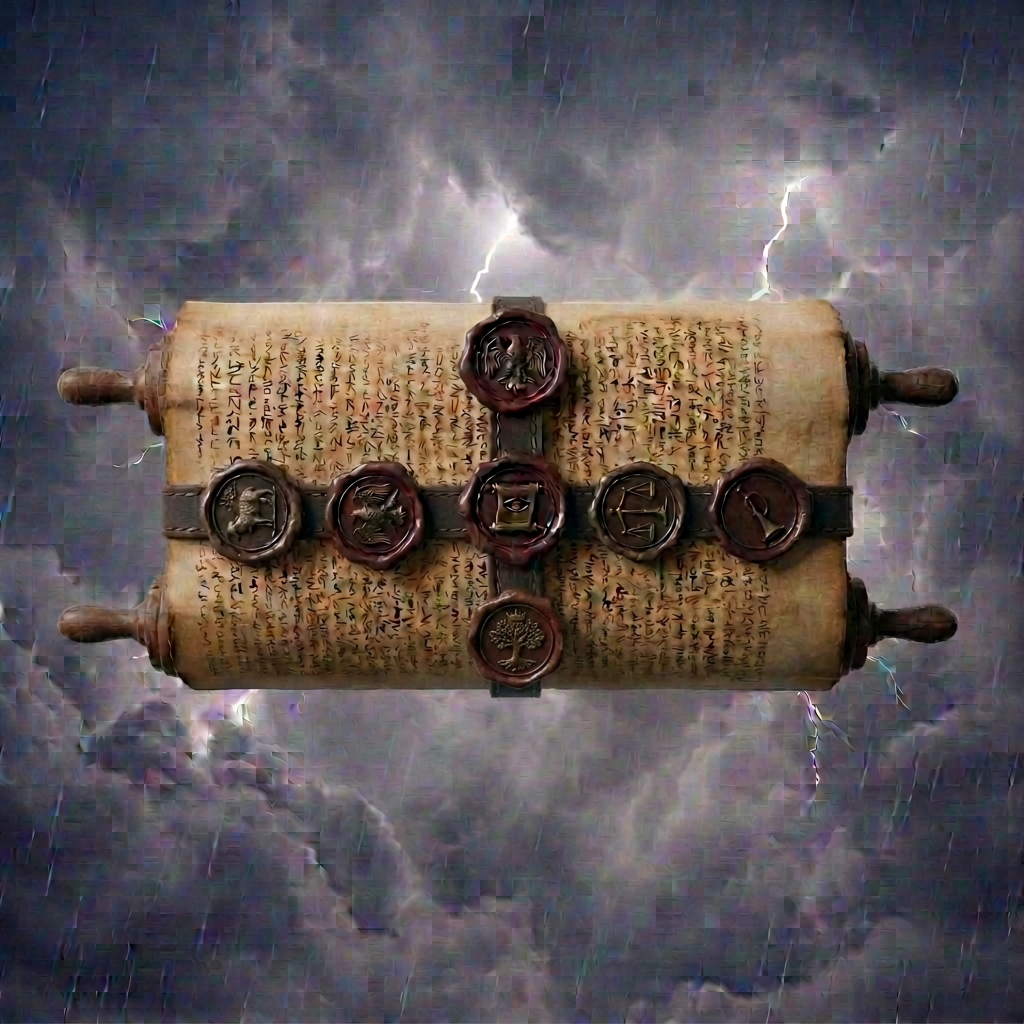
Weathered manuscript scroll with Hebrew text and seven wax seals

John weeping bitterly represents not only his personal despair but also the longing of all believers and creation for redemption, (Romans 8:18-23). Our yearning for hope and restoration lies in the opening and the unfolding of the scroll. As we will see in future chapters, the scroll contains the revelation and completion of God’s divine plan.

By the elder referring to Jesus as the Lion of the tribe of Judah and the heir to David’s throne, he is acknowledging the royal lineage of Jesus in humanity that fulfills ancient prophecy. The title “Lion of the tribe of Judah” not only emphasizes strength and majesty but also connects Jesus to a promise that dates back to the patriarch Jacob. In Genesis 49:7-9, God says that all of Judah’s relatives will bow before Judah, illustrating the destiny of this tribe among the people of Israel. In 2 Samuel 7:15-17, God tells Nathan the prophet that David will always have an heir on the throne, signifying a divine promise of kingship that would be fulfilled through Jesus. This royal heritage is the fulfillment of God’s covenant with David, representing a profound truth that culminates in the life and mission of Jesus, whose kingship brings hope and redemption to humanity.

Both of these titles not only signify strength and majesty but also reinforce the significance of Jesus in God’s divine plan for redemption. Throughout Scriptures, lions are seen as predators and strong, representing courage and authority. Yet in Isaiah 11:6-10 and 65:25, the Day of the Lord describes a time when the lion and the lamb will lie together, an era of harmony and peace. This paints a picture of how the world will be renewed after the return of Jesus, when all creation will be restored to its intended state of tranquility. During this time, human conflict will cease, and unity will prevail; Jesus’ reign brings a profound peace that surpasses all understanding, promising hope for all who believe. The anticipation of such a glorious future encourages faith and inspires believers to look forward to the fulfillment of God’s promises.

No one was found to be worthy to open the scroll because throughout history mankind has struggled with sin, every person has fallen short of the glory of God (Romans 3:23). In our human failure, it is only the Son of God who, through His unparalleled sacrifice, conquered sin and death, offering hope and salvation to all who believe in Jesus. The elder declares to John that Jesus has won the victory, He has triumphed over sin and death. While this statement comforts John in his sadness, it is much more than that. The victory of Jesus is the hope and the promise of eternal life for all believers.

Let’s pray. Father in heaven, thank You for Jesus, who is our guiding light and the embodiment of Your love. Thank You for our churches, where we gather as a community, drawing strength and support from one another in our spiritual journeys. Thank You for the wisdom that we have in the Bible, a powerful tool that illuminates our path and teaches us Your ways. Lord, help us to apply Your Word in our everyday lives, to live with kindness, compassion, and integrity in all that we do. Lord, as we delve into the profound teachings of Revelation, give us understanding and discernment, that we may grasp the hope and promises within. Let us be vigilant, keeping our hearts aligned with Your will as we navigate the trials of life. In Jesus’ precious name we pray, amen.
The Book of Revelation: Chapter 5, The Scroll Part 1

We have been working through a series on the book of Revelation. This book of the Bible can be difficult to understand for a variety of reasons, so we are taking it slow and studying it bit by bit together.

In Chapter 4, John the author of Revelation, was called by Jesus to come up in the Holy Spirit and enter God’s throne room. John describes all that he sees in Chapter 4 so we know what the throne room looks like and who is there. John continues telling us what he sees in Chapter 5, verse 1.

“Then I saw a scroll in the right hand of the one who was sitting on the throne. There was writing on the inside and the outside of the scroll, and it was sealed with seven seals. 2 And I saw a strong angel, who shouted with a loud voice: “Who is worthy to break the seals on this scroll and open it?” 3 But no one in heaven or on earth or under the earth was able to open the scroll and read it.”

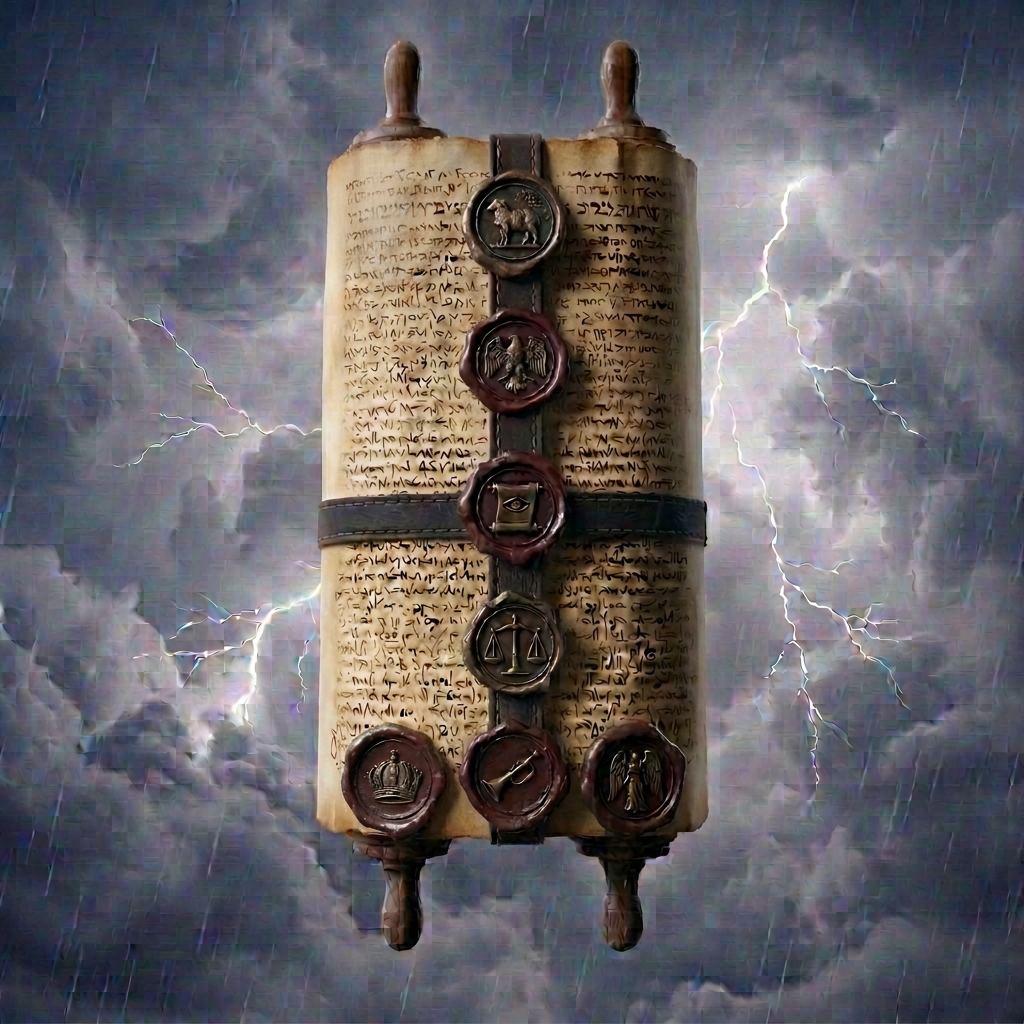
Weathered manuscript scroll with Hebrew text and seven wax seals

John sees a scroll in the right hand of God the Father as He sits on His throne. The scroll has writing on the inside and outside of it, which indicates that there was too much to fit on just the one side. There is a very similar scroll described by Ezekiel when he is taken up by the Holy Spirit to the open heavens, much like John. Ezekiel writes in Chapter 2 verse 9, “Then I looked and saw a hand reaching out to me. It held a scroll, 10 which he unrolled. And I saw that both sides were covered with funeral songs, words of sorrow, and pronouncements of doom.”

This scroll was given to Ezekiel, covered with messages of lament from God to His people, revealing the deep sorrow and urgency of God’s message. The Israelites had rejected their God, turning away from the covenant and the sacred ways they were called to follow. This painful rejection led to the inevitable consequences of the pronouncements of doom. The judgments outlined on the scroll were intended not merely as warnings but as a divine call to repentance, meant to stir the hearts of God’s people back to Him. The scroll served as both God pouring out His heart in lamentation and an urging for the rebellious to reconsider their path and embrace the redemption that lay before them.

Scrolls were typically used for contracts and were sealed with wax, such as with a signet ring, to keep the contents of the scroll private. The use of wax seals not only served to maintain confidentiality but also symbolized authenticity, as the signet ring would mark the wax with a distinctive impression unique to the owner. In this instance, God’s scroll was sealed until the time was appropriate to reveal its contents. The number of seals, seven, is a sign of completion in the Bible. The unrolling of this scroll and the events contained in it are the completion of God’s divine plan.

John sees “a strong angel, who shouted with a loud voice: ‘Who is worthy to break the seals on this scroll and open it?'” In Ezekiel, God Himself opened the scroll, demonstrating His supreme authority; however, in this instance, John observes an angel, much like a royal herald, making a proclamation on behalf of a King. The announcement of the angel emphasizes the need for divine intervention.

In verse 3, John hears from the angel herald, “But no one in heaven or on earth or under the earth was able to open the scroll and read it.”

As God is all-knowing, there is no actual search made across all of His Kingdom in the heavenly heights and the earthly domain to find someone deemed worthy to open the scroll. The point underlines the gravity of the scroll’s contents and the worthiness and the qualifications necessary to unveil the mysteries held within. All of creation waits for the revelation of what the scroll holds and no one is found worthy, until . . . .

Thank You, Heavenly Father, for the gift of Jesus, our Savior and Redeemer. We are grateful for His love, grace, and the hope He brings into our lives. Thank You for His sacrifice, which reconciles us with You and provides eternal life. May we always cherish His teachings and strive to follow His example of love and humility. As we journey through life, help us to reflect His light in all we do, inspiring others to seek Your presence. In Jesus’ name, we offer this prayer, amen.

The Book of Revelation: Chapter 4, The Throne Room Part 3

We have been working through a series on the book of Revelation. This book of the Bible can be difficult to understand for a variety of reasons, so we are taking it slow and studying it bit by bit together. As we continue our study of Chapter 4, John was invited by Jesus to enter God’s throne room.

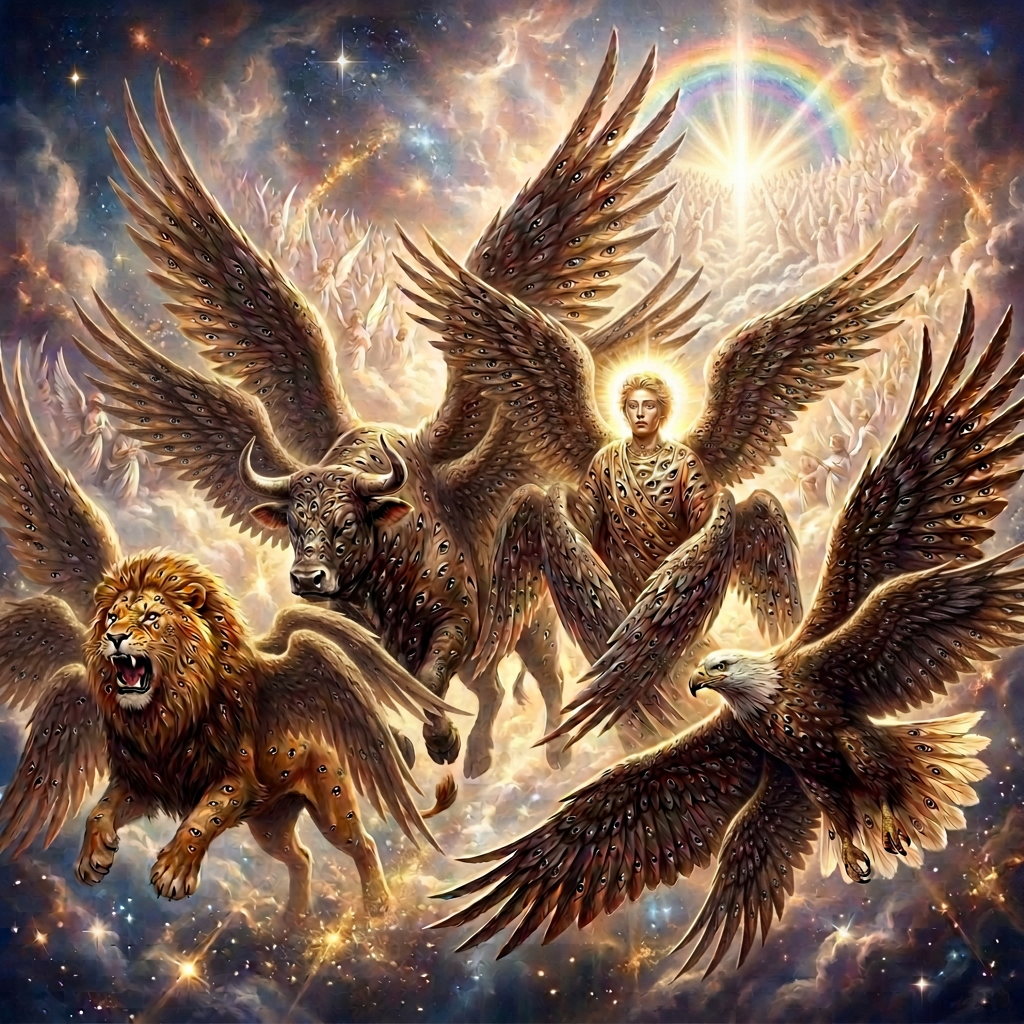
In Verse 6, John describes what he sees, “In front of the throne was a shiny sea of glass, sparkling like crystal. In the center and around the throne were four living beings, each covered with eyes, front and back. 7 The first of these living beings was like a lion; the second was like an ox; the third had a human face; and the fourth was like an eagle in flight. 8 Each of these living beings had six wings, and their wings were covered all over with eyes, inside and out.”

Eyes covering every wing

John describes something that looks like a sea of shiny glass before the throne. John probably did not have the words to describe what he was seeing, so he chose things on earth to try to paint the picture, drawing from the familiar sights of his everyday life. John was exiled to the Isle of Patmos when he wrote Revelation, a place surrounded by water, so the sea would have been a thing he saw all the time. He saw the sea both calm and in rough times. At this point in John’s description, the sea is calm, evoking a sense of peace and divine serenity. Yet, in contrast, we will see in Revelation 15:2, the sea becomes mixed with fire, which signifies judgment.

John then proceeds to describe four living beings, each covered with eyes. The multitude of eyes serve as a representation of omniscience. These beings and their eyes have also been described in Ezekiel, Chapter 1. While John is not told anything about the living beings, it is possible that the four beings represent all of God’s creation. What John does make clear is that the living beings have eyes in the front, the back, and their wings are covered all over with eyes, emphasizing their ability to observe God’s creation from every angle. The four living beings play a key role in the upcoming wrath of God on the earth and those who do not believe that Jesus is the Son of God.

In verse 8, John depicts the continuous worship that the living beings express. Their ceaseless proclamation of praise articulates the majesty of the Lord God, the Almighty.

“Day after day and night after night they keep on saying,

‘Holy, holy, holy is the Lord God, the Almighty—
    the one who always was, who is, and who is still to come.’ “

This song is about the eternal nature of God, emphasizing His unchanging presence across all time. In verse 9, John continues to describe what is happening as the living beings sing praise to God. “Whenever the living beings give glory and honor and thanks to the one sitting on the throne (the one who lives forever and ever), 10 the twenty-four elders fall down and worship the one sitting on the throne (the one who lives forever and ever). And they lay their crowns before the throne and say,

11 ‘You are worthy, O Lord our God,
    to receive glory and honor and power.
For you created all things,
    and they exist because you created what you pleased.’ ”

As the living beings give glory, honor, and thanks to the one seated upon the throne, this act of worship stimulates an immediate response from the twenty-four elders. In verse 10, we see them fall down, embodying humility and surrender before the authority of God. Their act of laying down their crowns symbolizes recognition of God’s supreme authority and their submission to His will.

In unison, they proclaim:

“You are worthy, O Lord our God,
    to receive glory and honor and power.
For you created all things,
    and they exist because you created what you pleased.”

This declaration highlights the whole creation’s reliance on God as the Creator. It acknowledges not just His role as the originator of all that exists but also celebrates the purpose behind creation, that everything exists for His pleasure and glory. This theme resonates throughout the Scriptures, reminding believers that we are created to bring God glory. May we daily join the continuous cycle of worship that exists in the heavenly realms, where the glory of God is perpetually declared and honored.

Let’s pray. Father in heaven, thank You for Jesus, our Savior and Redeemer, whose love knows no bounds. Thank You for our churches, the places of worship and community that nurture our faith and strengthen our bonds with one another. Thank You for the wisdom that we have in the Bible, a guide to our lives and a source of comfort in times of distress. Lord, help us to apply Your Word in our everyday lives, that we may reflect Your love and grace in our actions and interactions. Help us to understand the lessons it teaches, so that we may grow closer to You. Lord, as we seek to study Revelation, grant us clarity and insight, revealing the truths contained within its pages. In Jesus’ precious name we pray, amen.
The Book of Revelation: Chapter 4, The Throne Room Part 2

We have been working through a series on the book of Revelation. This book of the Bible can be difficult to understand for a variety of reasons, so we are taking it slow and studying it bit by bit together. We continue our study of Chapter 4 as John is invited to enter God’s throne room.

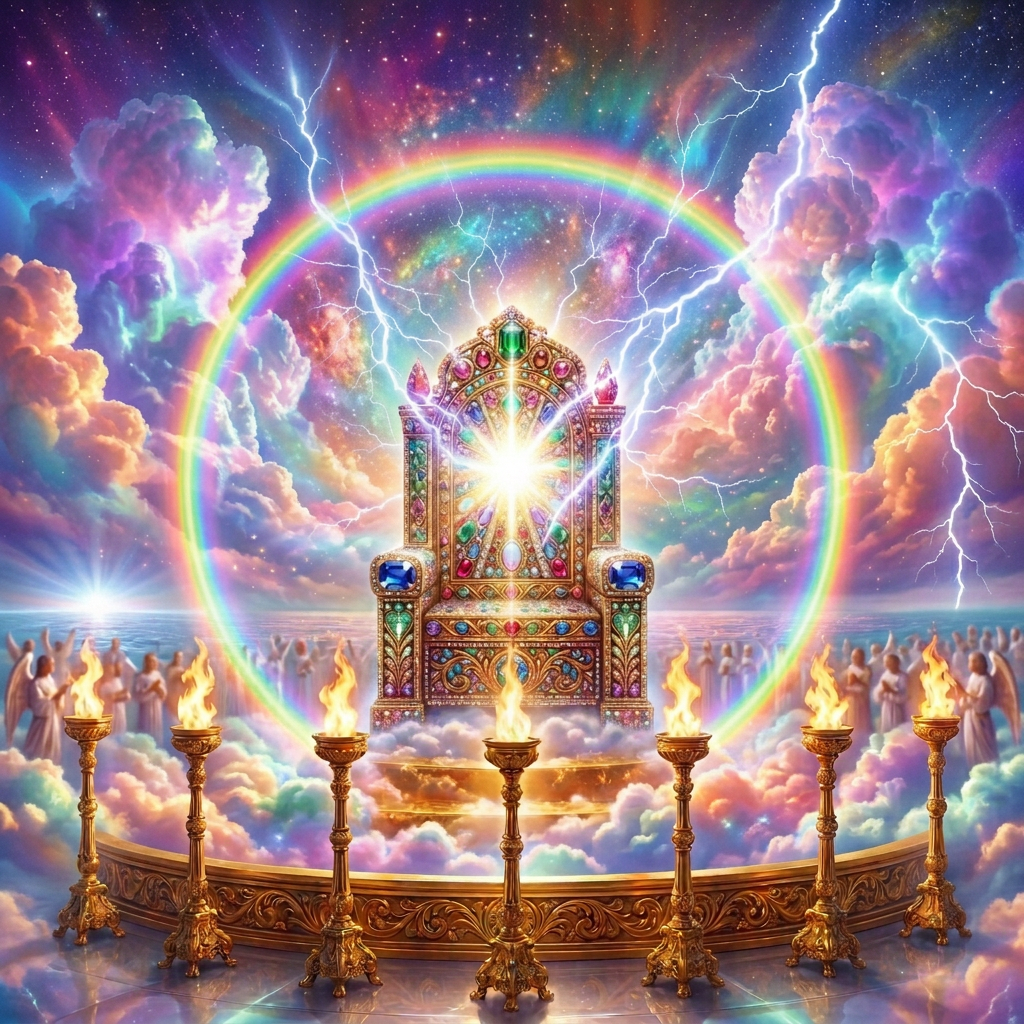
In verse 5, John describes what he saw. “From the throne came flashes of lightning and the rumble of thunder. And in front of the throne were seven torches with burning flames. This is the sevenfold Spirit of God.”

Radiant figure seated on jeweled throne amid lightning and candles

John continues to describe the power and majesty of God, painting a vivid picture of divine splendor. From His throne comes lightning and thunder, signaling His authority and wondrous might over the universe. God is the Creator of all things; everything flows from Him, including the very forces of nature.

In front of God’s throne are seven torches with burning flames. These seven torches are the sevenfold Spirit of God, the Holy Spirit. It is essential to note that these torches are not to be confused with the seven lampstands that we read about in Chapter 1 of Revelation, which represent the seven churches. We studied the seven lampstands that Jesus walks among in a prior post. Instead, the seven torches signify the fullness of the Holy Spirit, emphasizing the divine presence that guides, inspires, and empowers believers.

May we picture the vibrant colors of heavenly glory around us as we approach the throne in prayer (Hebrews 4:16), inviting us into a deeper communion with Him. Each time we pray, we enter a sacred space. In the throne room are the Father, the Son and the Holy Spirit surrounded by a multitude of angels, heavenly creatures, and 24 elders, whose voices rise in worship. When we pray and praise, we join those in the throne room and declare the majesty of the Creator, celebrating His sovereignty and grace. May we sing praises to our God, reminding us of the unfathomable love and mercy that flows from Him, nourishing our spirits and renewing our hearts.

Let’s pray. Father in heaven, thank You for Jesus, our light and hope. Thank You for Your love that surrounds us daily. Thank You for the Bible, which guides and inspires us through life’s challenges. Help us to apply Your Word in our lives, reflecting Your love and grace in our relationships. Guide us as we study Revelation, giving us understanding of its mysteries. May Your Holy Spirit enlighten us and help us live according to Your will. In Jesus’ name we pray, amen.

The Book of Revelation: Chapter 4, The Throne Room Part 1

We have been working through a series on the book of Revelation. This book of the Bible can be difficult to understand for a variety of reasons, so we are taking it slow and studying it bit by bit together. As we begin our study of Chapter 4, John is invited to enter God’s throne room.

In verse 1 of Chapter 4, John writes, “Then as I looked, I saw a door standing open in heaven, and the same voice I had heard before spoke to me like a trumpet blast. The voice said, ‘Come up here, and I will show you what must happen after this.’ ” 

Up to this point in Revelation, Jesus was telling John what to write. In Chapter 4, John begins to describe in his own words what he sees. Jesus literally opens the door to heaven’s throne room and tells John to come up. Heaven is not accessible to humans except through Jesus. John 14:6 says, “Jesus told him, ‘I am the way, the truth, and the life. No one can come to the Father except through me.’ “

God the Father is in the throne room of heaven and the only way to Him is through Jesus opening the door. If someone who does not believe in Jesus as the Son of God tries to open the door, they are forbidden entrance (see Matthew 25 where Jesus uses several parables to explain this).

When Jesus says He is going to show John what must happen after “this”, He is referring to after the Church age. “This” is the present time we are living in, which we studied in a prior post. Jesus is revealing to us what the future holds, He does not want us to be unaware.

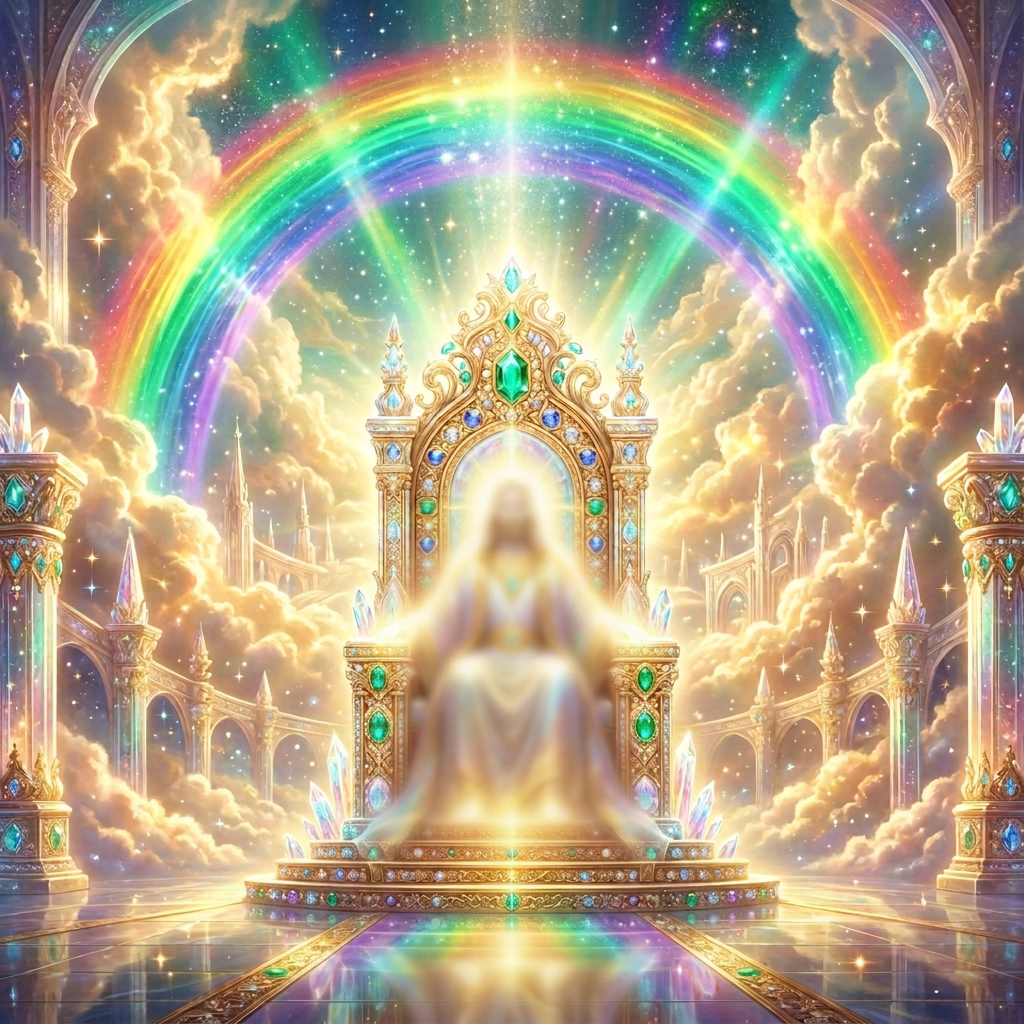
As we enter the throne room of heaven, there is constant activity and songs of praise to God. It is a room filled with God’s glory, grace, and joy. God’s beauty and magnificence create a radiant light, and there is an atmosphere of worship, reverence, and adoration.

Radiant faceless figure seated on jeweled throne beneath a rainbow

Beginning in verse 2, John describes what he saw. “And instantly I was in the Spirit, and I saw a throne in heaven and someone sitting on it. 3 The one sitting on the throne was as brilliant as gemstones—like jasper and carnelian. And the glow of an emerald circled his throne like a rainbow.”

John is led by the Holy Spirit through an open door into heaven’s throne room, guiding him into the very presence of God. Every believer has this gift, the Holy Spirit can take us to the throne room right now. Through our belief in Jesus as the Son of God, we are invited to the throne of grace (Hebrews 4:16). John sees God on His throne and attempts to describe the incredible glory surrounding Him. Scriptures tell us that God is light, so there is no need for the sun or moon in heaven since God’s glory provides the light (1 John 1:5, Revelation 21:23). John uses jewels and colors to depict the breathtaking beauty that surrounds God.

In verse 4, John continues to describe what he sees. “Twenty-four thrones surrounded him, and twenty-four elders sat on them. They were all clothed in white and had gold crowns on their heads.”

The 24 elders sitting on thrones are the 12 patriarchs from the Old Testament and the 12 apostles from the New Testament, illustrating the unity of God’s people across both covenants. These elders have several roles that emphasize their importance in the heavenly realm. They sing praises to God and fill His throne room with songs of worship. Another significant role of the elders is to interpret the visions that John will see in Chapters 5 and 7, guiding him through the complexities of divine revelation. The elders are wearing white, the same as the other believers described throughout the book of Revelation, symbolizing purity and holiness. Jesus is also described as wearing white; we studied this topic in a prior post.

God’s throne room is the center of the rest of the book of Revelation. As we study the throne room and the wrath that will occur on earth, we must remember these are not fairy tales. The throne room exists today, Jesus is seated at the right hand of God the Father today (Matthew 26:64, Mark 14:62 and Hebrews 12:2).

Let’s pray. Father in heaven, thank You for Jesus, who is our guiding light and hope. Thank You for Your immense love for us, which surrounds us in every moment of our lives. Thank You for the wisdom that we have in the Bible, a treasure trove of guidance and inspiration that helps us navigate the challenges of this world. Lord, help us to apply Your Word in our everyday lives, that we may reflect Your love and grace in our actions and relationships with others. Lord, help us to study Revelation with open hearts and minds, and give us understanding as we seek to grasp the mysteries within it. May Your Holy Spirit illuminate our souls and grant us the discernment to live according to Your will. In Jesus’ precious name we pray, amen.
The Book of Revelation: Chapter 4 Overview

We have been working through a series on the book of Revelation. This book of the Bible can be difficult to understand for a variety of reasons, so we are taking it slow and studying it bit by bit together. As we begin our study of Chapter 4, John is invited to enter God’s throne room.

Chapter 4 is focused on John describing what the throne room looks like and it is an amazing sight! While Chapter 5 is still in the throne room, the revelation of Jesus changes from one of beauty and joy to one of warning.

In the throne room are the Father and the Son, who are sovereign and hold all power in their hands. They are surrounded by a multitude of angels, whose voices rise in worship, creating a scene of reverence and awe. As the book of Revelation continues to unfold, the worship in the throne room transitions dramatically to stark scenes of the unleashing of God’s wrath upon the earth. Those who do not believe in Jesus as the Son of God are exposed to the profound depths of God’s judgment. The purpose of this judgment is not merely punitive but serves as a crucial opportunity for those who do not believe to repent, turning their hearts towards the grace and mercy that is extended through faith in Christ. It is a solemn reminder of the duality of God—love and judgment coexist, urging humanity towards Jesus.

As we proceed to study the throne room and the awful wrath on earth, we must remember these are not fairy tales. The throne room exists today, Jesus is seated at the right hand of God the Father – today (Matthew 26:64, Mark 14:62 and Hebrews 12:2). The wrath that is to be poured out on the earth will indeed happen, and it serves as a reminder of God’s justice and the consequences of sin. If you have accepted Jesus as the Son of God, then you will be saved and protected from this impending judgment. However, if you have refused the gift of salvation that Jesus offers, then you will endure the wrath of God; whether at the moment of your death or when Jesus returns and if you are alive on earth during that time. This urgent message carries the importance of the need for each individual to reflect upon their spiritual state. If you are saved, who do you need to tell about Jesus so they can also avoid the wrath of God and experience the hope and joy that comes from eternal life? Who needs your words to open the door for them to also embrace the truth and grace found in accepting Christ as their Savior?

Let’s pray. Father in heaven, thank You for Jesus. Thank you for our churches. Thank You for the wisdom that we have in the Bible. Lord, help us to apply Your Word in our everyday lives. Lord, help us to study Revelation and give us understanding. In Jesus’ precious name we pray, amen.
The Book of Revelation: Connecting Chapters 3 and 4

We have been working through a series on the book of Revelation. This book of the Bible can be difficult to understand for a variety of reasons, so we are taking it slow and studying it bit by bit together.

As we finish our study of the seven letters to the churches in Chapters 2 and 3, it’s important to remember that the seven churches represent all churches; every church fits into one of the seven types described by Jesus. Also in each letter, Jesus made a promise to believers who stay strong in their faith; these promises apply to all believers throughout time.

The last promise Jesus made in the letters to the churches is in Chapter 3, verse 21. “Those who are victorious will sit with me on my throne, just as I was victorious and sat with my Father on his throne.”

Next week, we will begin to study Chapter 4 of Revelation, a pivotal part of the text that draws us deeper into the divine revelation. John will be told to “come up” to heaven. During the initial chapters of Revelation, Jesus guides John through a series of revelations that are meant to encourage and instruct the various churches. In Chapter 4, Jesus tells John to come to the throne room in heaven, a magnificent and awe-inspiring experience where God’s glory is fully manifested. This is the same throne that Jesus talked about in His promise to all believers when He stated, “Those who are victorious will sit with me on my throne, just as I was victorious and sat with my Father on his throne.” This promise to be in the presence of Jesus’ divine authority serves as a powerful reminder of the hope that awaits believers. Just as John was invited into this heavenly reality, we have an invitation of our own; beckoning us to deeper communion with the divine and a fuller understanding of the heavenly promises that lie ahead.

Let’s pray. Father in heaven, thank You for Jesus. Thank you for our churches. Thank You for the wisdom that we have in the Bible. Lord, help us to apply Your Word in our everyday lives. Lord, help us to study Revelation and give us understanding. In Jesus’ precious name we pray, amen.